Can GPT-Realtime Replace Customer Support Agents? What Businesses Should Know
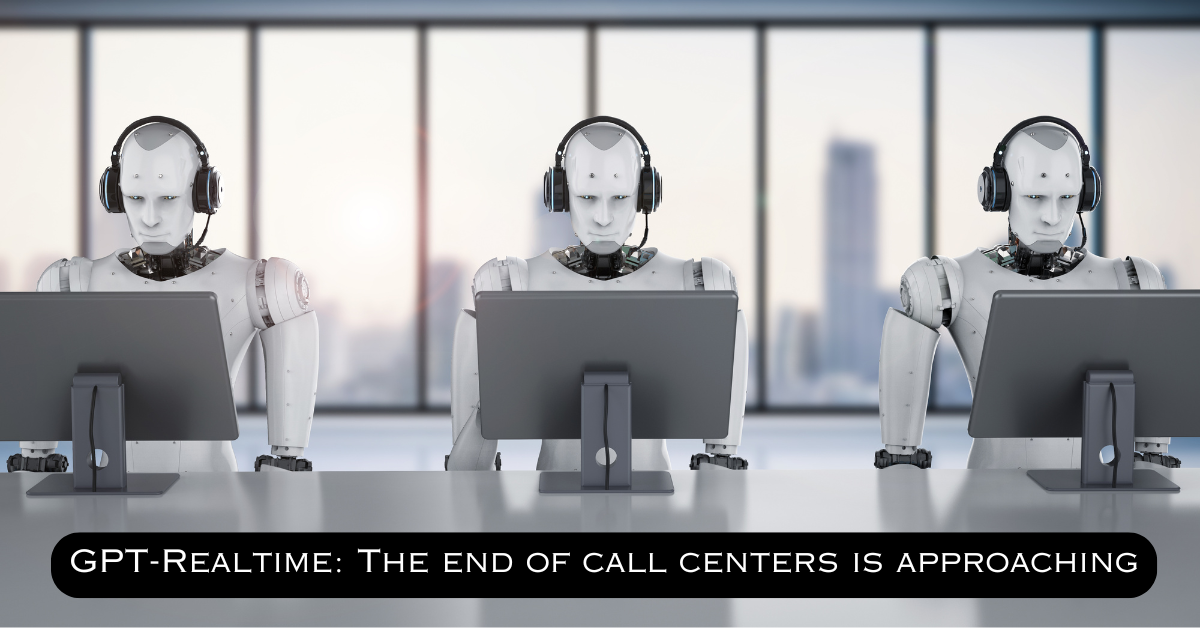
OpenAI’s real-time voice technology lets assistants listen, respond naturally, handle interruptions, and use software tools during a conversation. For customer service teams, that creates a significant opportunity: AI can handle routine calls faster and at any hour. It also raises a difficult question: what happens to the human employees whose work AI can automate?
Not every support role will disappear overnight. Instead, many teams may combine AI for routine interactions with human employees who manage exceptions, sensitive cases, complex decisions, and quality control. The pace of change will depend on the business, the task, and the quality of its system.
Table of Content
What is GPT-Realtime?
OpenAI announced GPT-Realtime and updates to its Realtime API on August 28, 2025. The technology supports speech-to-speech interaction. Instead of always converting speech to text, generating a text response, and then turning that response into speech, a real-time model can process audio and respond directly with audio. That approach can make an AI assistant feel more conversational through lower latency and more natural turn-taking. The Realtime API also supports tool or function calls, so a voice agent can retrieve information or initiate actions through an application’s backend. See OpenAI’s launch announcement and Realtime conversation documentation.



A model alone does not make a complete customer-support system. Businesses still need application logic, verified access to customer and product data, authentication, escalation rules, monitoring, and careful handling of transcripts or call recordings before they launch a production service.
What can a real-time AI support agent do?
With the right integrations and controls, a voice agent can help customers check order status, compare product options, understand billing information, follow troubleshooting steps, or find the right plan. Function calling can connect the conversation to approved systems, so the assistant can retrieve current information instead of relying only on what it learned during training.
However, the system can still make mistakes, misunderstand a customer, or mishandle an unusual situation. Businesses should limit the actions an AI agent can take, validate sensitive operations, and offer a clear handoff to a human employee when the system lacks confidence or the issue falls outside its scope.
Is OpenAI’s real-time voice technology still new?
GPT-Realtime marked a notable launch in 2025, but it is no longer a brand-new product in 2026. OpenAI’s current documentation lists the original gpt-realtime model as deprecated and describes newer real-time model options. OpenAI’s audio guidance also recommends GPT-Live as a starting point for new conversational voice applications, while the Realtime API remains relevant for use cases that need its session and tool model. Developers should check the current audio and voice guide and API pricing before choosing a model or estimating deployment costs.
Model capabilities and prices change over time. The launch-era price of one model does not provide a reliable estimate of what a business will pay today. Actual costs depend on audio input and output, cached input, model choice, conversation length, tool use, telephony, and surrounding infrastructure. Check OpenAI’s current pricing rather than copying figures from an older article.
Why businesses are interested in AI customer support
Customer support plays a costly and highly visible role in a company’s relationship with customers. Long wait times, limited opening hours, and repetitive processes frustrate customers. Meanwhile, staffing a large team to cover every hour and language can strain a company’s budget.
A well-designed voice agent can answer common questions outside normal business hours, reduce queue times, handle repeated tasks consistently, and route complicated cases to human staff. It can also help employees by summarizing previous interactions or retrieving information while an agent handles the conversation.
Automation does not guarantee a better customer experience. An AI assistant can damage a company’s reputation if it traps people in a loop, gives incorrect advice, or makes it difficult to reach a human. The goal should be fast, accurate resolution, not simply fewer employees or fewer calls handled by people.
Real-world examples: T-Mobile and Salesforce
T-Mobile’s AI assistant
T-Mobile has publicly discussed its work with OpenAI on AI-assisted customer experiences. In 2025, the company began rolling out a conversational AI assistant in its T-Life app to help customers with device upgrades, compare phone features and offers, and access account-specific information. The product shows how voice AI can connect to live pricing, inventory, promotions, and customer data instead of acting as a standalone chatbot. Read T-Mobile’s official IntentCX announcement and its T-Life product update.
This example shows that voice AI has entered practical customer journeys. It does not prove that every customer-service function can operate without people or that this assistant alone eliminated a specific number of jobs.
Salesforce’s reduction in support headcount
In September 2025, Salesforce CEO Marc Benioff said the company had reduced its customer-support workforce from roughly 9,000 people to about 5,000 as AI agents took on more interactions. Outlets including the Los Angeles Times and The Register reported his remarks. His comments show that AI adoption can accompany real workforce changes, although one company’s experience cannot predict the future for the entire sector.
Salesforce has also discussed moving some employees into other functions, including sales. Employers may choose reassignment, but no company can guarantee that outcome for every worker.
Will AI voice agents replace customer support staff?
Voice technology can automate some tasks that human agents perform today, especially repetitive, rules-based conversations. As a result, some teams may need fewer roles when AI can resolve a large share of customer contacts through standard workflows.
Still, the employment picture goes beyond “AI replaces every agent.” A Gartner survey published in April 2026 found that 31% of surveyed customer-service and support leaders had implemented or planned AI-driven frontline layoffs through the first quarter of 2027. At the same time, 85% said they were expanding human agents’ responsibilities, with workforce redesign more common than role elimination in the survey. See Gartner’s research announcement.
These figures reflect a survey of service and support leaders; they do not predict what every employer will do. Even so, they point to two trends at once: some organizations are reducing staffing needs, while others are changing the work human agents do.
Tasks AI can often automate
- Answering routine questions about hours, policies, orders, or basic account information.
- Providing standard troubleshooting steps and collecting initial details.
- Routing customers to the right team and summarizing the issue.
- Completing simple actions through approved systems after the application checks identity and permissions.
Tasks where people remain important
- Handling complaints that require judgment, empathy, or negotiation.
- Resolving unusual or high-risk cases involving money, safety, privacy, or account access.
- Making exceptions and taking responsibility when a standard workflow fails.
- Reviewing AI quality, correcting errors, managing escalations, and improving support processes.
The balance will vary by industry. Financial services, healthcare, telecoms, and other regulated or high-impact settings may need stricter controls and clearer human escalation than businesses that answer general product questions.
The challenges companies must solve before scaling voice AI
Accuracy and access to live information
A support assistant must not invent a refund policy, promotion, stock status, or account detail. It should retrieve information from approved systems and tell the customer when it cannot verify an answer. For high-impact actions, businesses should add safeguards outside the language model itself.
Privacy, security, and recording
A speech-to-speech model does not resolve every question about call recording or compliance. Organizations must decide which audio, transcripts, and logs to store; restrict access; explain recording where required; and follow the privacy and communications laws that apply to their customers and locations. The application—not the model’s judgment—must enforce authentication and authorization.
Escalation and accountability
Customers need a reliable way to reach a person. Businesses should define clear escalation triggers, transfer conversation context, and assign human ownership of difficult cases. Teams should also monitor failed resolutions and repeat contacts, not just containment rates or average call duration.
Total cost of ownership
A voice agent costs more than its model’s audio tokens. Businesses may also pay for phone connectivity, engineering, customer-data integrations, monitoring, security, evaluation, and human review. During a pilot, measure the cost per successfully resolved contact and compare it with the full cost and quality of the existing service.
What should support employees do now?
Workers cannot control every decision an employer makes, but they can prepare for the parts of the job that AI may change. Useful skills include handling complex escalations, writing and maintaining knowledge-base content, analyzing customer feedback, testing AI responses, identifying recurring issues, and using approved AI tools safely. Product knowledge, clear communication, judgment, and empathy remain valuable when conversations become unusual or emotionally charged.
Employers also need to communicate honestly about role changes, offer retraining where feasible, and avoid presenting redeployment as guaranteed when it is not. When AI supports human agents, employees should help define handoff rules and identify failure cases.
Conclusion: expect a hybrid model, not a simple switch
Real-time voice AI gives companies a practical customer-service tool, and some employers will use it to reduce staffing needs. Businesses should not dismiss that risk. At the same time, model capabilities, prices, customer expectations, privacy obligations, and business processes continue to evolve. The outcome will vary across companies: some will automate large volumes of routine conversations, while others will use AI mainly to support human agents.
Businesses should ask not only how many calls AI can handle, but also whether customers receive accurate answers and can reach a person when needed. Support workers should build skills in complex problem-solving, customer judgment, and AI-assisted operations rather than assume either complete replacement or complete job security.
For a related explanation of how conversational agents differ, see OutreachWay’s guide to AI agents vs. chatbots.
Frequently asked questions
Is GPT-Realtime the same as a chatbot?
Not exactly. A text chatbot mainly interacts through written messages, while a speech-to-speech real-time model can listen and respond with audio. Both can use tools and business data when the application gives them access.
Can a real-time AI agent handle customer calls without human help?
It can handle selected, well-defined workflows when businesses connect it to reliable systems and add guardrails. Companies should keep a human escalation path for complex, sensitive, or unresolved cases.
Does GPT-Realtime record calls automatically?
The model does not act as a complete recording and compliance system by itself. The application and organization must manage recording, transcript storage, retention, access controls, and customer notices.
How much does OpenAI’s Realtime API cost?
Pricing depends on the model and usage. OpenAI may bill audio input, audio output, cached input, and other components differently. Check the current official pricing page before estimating costs for a real deployment.
Will AI eliminate all customer-service jobs?
No reliable evidence supports the claim that every customer-service job will disappear. Some employers are reducing certain tasks and roles, while other teams are changing human agents’ responsibilities. Outcomes depend on the employer, type of support, AI quality, and approach to retraining and redeployment.
Editorial note: This article discusses technology and workforce trends, not a forecast for any individual employer. Product documentation and pricing can change, so verify them before making implementation decisions.